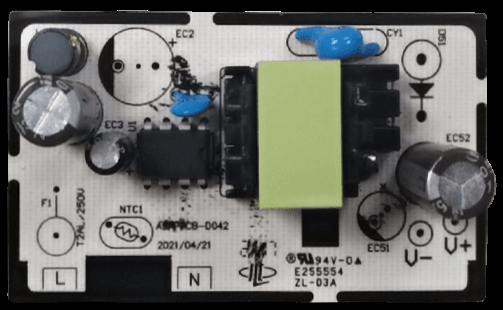
Background
Power adapter PCBAs have the following characteristics:
- Tight component spacing with high inter-component interference
- High insertion accuracy requirements
Under traditional manual insertion, 7 operators per shift were needed to handle 8 insertion positions, with an hourly output of about 1,000 pcs and daily output of 16,000 pcs. Manual operations were prone to missed insertions, wrong placements, and component floating issues.
Solution
After introducing CTW's automated odd-form insertion equipment, board material layout was optimized to further boost productivity. The equipment automatically completes all 8 insertion positions, requiring only 0.5 person for patrol inspection.
Automation Comparison
| Item | Staff/Shift | Insertions | Hourly Output | Hours/Day | Output/Shift (PCS) | Daily Output (PCS) |
|---|---|---|---|---|---|---|
| Manual | 7 | 8 | 1,000 | 20 | 8,000 | 16,000 |
| Automated | 0.5 | 8 | 1,200 | 22 | 13,200 | 26,400 |
Key Benefits
- Staff reduction: From 7 to 0.5 per shift, saving over 90% labor costs
- Output increase: Daily output from 16,000 to 26,400 pcs, 65% improvement
- Quality assurance: Eliminated missed insertions, wrong placements, and floating defects
- Stability: Avoided human fatigue-related errors, more consistent quality
Summary
After automation, product quality improved significantly with zero floating, insertion, and reflow defects, saving labor costs and eliminating human errors.