Background
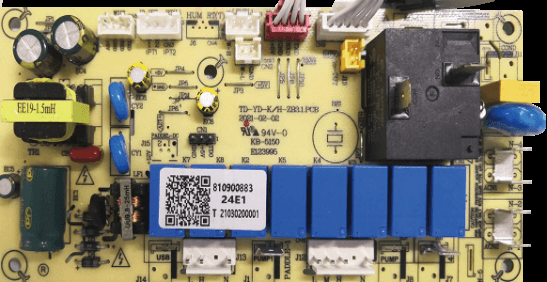
Home appliance PCBAs have the following characteristics:
- Frequent line changeovers with tight component spacing
- High inter-component interference, many direction-sensitive materials
- Multiple product varieties requiring flexible small-batch production
Under traditional manual insertion, 6 operators per shift handled 23 insertion positions with hourly output of about 350 pcs and daily output of 7,000 pcs.
Solution
Marked components are handled by automated insertion equipment using a human-machine collaboration approach. Shared materials between different products are automatically switched by the equipment, enabling flexible production.
Automation Comparison
| Item | Staff/Shift | Insertions | Hourly Output | Hours/Day | Output/Shift (PCS) | Daily Output (PCS) |
|---|---|---|---|---|---|---|
| Manual | 6 | 23 | 350 | 20 | 3,500 | 7,000 |
| Automated | 0.5 | 23 | 420 | 20 | 4,200 | 8,400 |
Key Benefits
- Staff reduction: From 6 to 0.5 per shift, saving over 90% labor costs
- Output increase: Daily output from 7,000 to 8,400 pcs, 20% improvement
- Flexible production: Automatic material switching between products, rapid line changeover
- Quality assurance: Eliminated insertion and reflow defects, more stable quality
Summary
After automation, product quality improved with zero floating, insertion, and reflow defects, saving labor costs and eliminating human errors.